

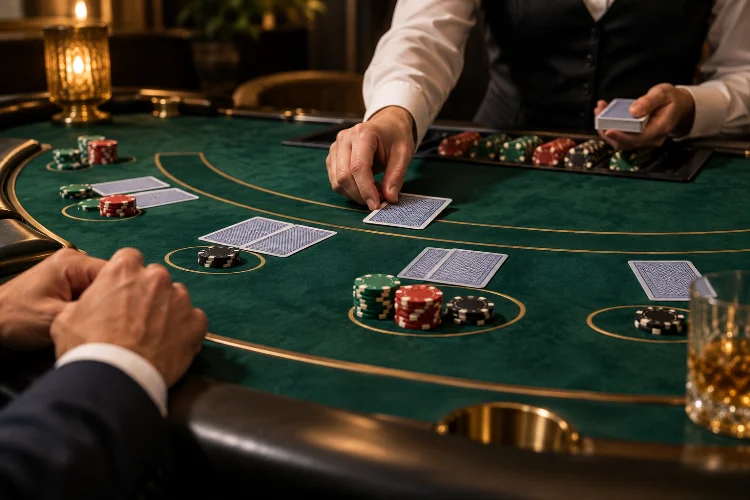
Blackjack already gives players several decisions, including hit, stand, double, and split. Many modern tables add another layer before the first hand is even finished: optional side bets with their own payouts and winning conditions.
With Blackjack Side Bets Explained clearly, these extra wagers become much easier to understand. Perfect Pairs may care only about your first two cards, while 21+3 combines your cards with the dealer’s up card.
Other wagers depend on totals or whether the dealer busts. The important point is that every side bet has mathematics separate from the main blackjack hand.
What Is a Blackjack Side Bet?
A side bet is an optional wager made alongside the normal blackjack bet.
The main blackjack wager asks whether your hand can beat the dealer without exceeding 21. A side bet can ask something completely different, such as whether your opening cards form a pair or whether three particular cards create a poker-style combination.
Modern live blackjack tables can offer several at once. Evolution, for example, lists Perfect Pairs/Any Pair, 21+3, Hot 3, and Bust It among optional side bets on some blackjack formats.
The two wagers are settled independently. You might lose the main blackjack hand but win the side bet, or the opposite.
That independance is important because each wager also has its own payout structure and house edge.
Perfect Pairs: Betting on Your First Two Cards
Perfect Pairs is one of the easiest side bets to understand.
It focuses on whether your first two cards have the same rank. Two Queens, for example, create a pair even if they come from different suits.
Some versions then divide qualifying pairs into categories. A mixed-color pair may receive a smaller payout, a same-color pair can pay more, and two completely identical cards from a multi-deck shoe can qualify as a perfect pair.
One eight-deck paytable analysed by Wizard of Odds pays 25:1 for a perfect pair, 12:1 for a colored pair, and 6:1 for another qualifying pair. Under that particular structure, the calculated house edge is about 4.10%.
That figure is not universal. A casino can use another paytable, so always check the game’s actual rules.
The appeal is straightforward: the result is known immediately after your first two cards arrive.
21+3 Turns Blackjack Cards Into a Poker Hand
The 21+3 side bet combines your first two cards with the dealer’s face-up card.
Instead of calculating a blackjack total, the three cards are treated like a three-card poker hand. Depending on the paytable, prizes can be awarded for combinations such as a flush, straight, three of a kind, straight flush, or suited three of a kind.
For example, one eight-deck version analysed by Wizard of Odds pays 100:1 for suited three of a kind, 40:1 for a straight flush, 30:1 for three of a kind, 10:1 for a straight, and 5:1 for a flush. Its calculated house edge is approximately 3.70%.
Other versions have substantially different percentages.
That shows why a large headline payout does not tell you whether the wager is mathematically favourable. Rare outcomes can justify impressive prizes while still leaving the casino with a meaningful long-term advantage.
Hot 3 Is About the Combined Card Total
Hot 3 also uses your first two cards plus the dealer’s up card, but it evaluates them differently.
Instead of poker hands, the bet mainly looks at the combined blackjack-style value of those three cards.
One common paytable awards prizes for totals of 19, 20, or 21, with larger payments for suited 21 and three sevens. In an eight-deck analysis, the house edge for that structure is about 5.40%.
A simple example makes the idea clearer.
Suppose you receive a 10 and 5 while the dealer shows a 6. Together the cards total 21, so the Hot 3 bet could win according to its paytable even though your normal blackjack hand is only 15.
This illustrates why side bets should be thought of as seperate mini-games sharing the same cards.
Is Insurance Really a Side Bet?
Yes, although insurance works somewhat differently from promotional side wagers such as Perfect Pairs.
Insurance is normally offered when the dealer shows an Ace. You are betting that the dealer’s hidden card is worth ten and therefore completes a natural blackjack.
Standard insurance commonly costs up to half of the original blackjack wager and pays 2:1 if the dealer has blackjack.
The wager can sound attractive because it appears to “protect” the original hand. Mathematically, though, it is a separate proposition.
Wizard of Odds calculates a house edge of about 5.9% for insurance in a standard single-deck example without card-counting information.
The exact probability changes with deck composition, which is why insurance behaves differently from simply reducing risk on the original hand.
Think of it as betting on the dealer’s hidden card, not purchasing guaranteed protection.
Dealer Bust Side Bets Work Differently Again
Some blackjack games let you wager that the dealer will exceed 21.
Evolution’s Bust It is an example of this general idea, while several other casino versions pay different amounts according to how many cards are needed before the dealer busts.
A six-deck Buster Blackjack structure analysed by Wizard of Odds, for instance, has payouts that grow when the dealer requires more cards to bust. Under one hit-soft-17 paytable, its calculated house edge is approximately 6.21%.
Again, the details matter enormously.
Another dealer-bust wager with a different payout structure can produce a completely different expected return. Even whether the dealer hits or stands on soft 17 can influence the probability.
Never assume all “dealer bust” bets are mathematically equivalent because their names sound similar.
Side Bets Can Change Your Real Stake Quickly
The table minimum can hide how much you are actually wagering per round.
Imagine a $10 blackjack hand with a $5 Perfect Pairs bet and another $5 on 21+3.
You are now risking $20 before making any later decisions such as doubling or splitting.
Over 20 rounds, that hypothetical player has put $200 into the base wagers but another $200 into side bets if both extras are placed every hand.
That does not mean exactly $400 will be lost. Wins can return money along the way.
It simply shows how quickly optional bets increase wagering volume.
This is particularly relevant because many side bets carry a higher house edge than a well-structured blackjack main game played with correct basic strategy.
The dramatic payouts are part of their appeal, but the additional stake should not be overlooked.
Read the Paytable Before Placing the Bet
The name of a side bet is only the starting point.
Check what qualifies, how much each outcome pays, the number of decks if relevant, and whether multiple prize categories exist.
Great Britain technical standards require applicable gambling rules, prizes, and information about the likelihood of winning to be available before customers commit to gamble.
That is good practical advice anywhere.
For example, two 21+3 tables could use different payouts for the same straight flush. That single change affects expected return even though both buttons say “21+3.”
The paytable tells you what you are really buying with the side wager.
With Blackjack Side Bets Explained, the key idea is simple: each optional wager is effectively a separate game attached to blackjack. Perfect Pairs, 21+3, Hot 3, Insurance, and dealer-bust wagers all use different winning conditions and payout maths.
Before adding one to your hand, read its paytable and consider the extra stake involved. Treat the side bet as optional entertainment rather than assuming it improves the underlying blackjack odds.
