
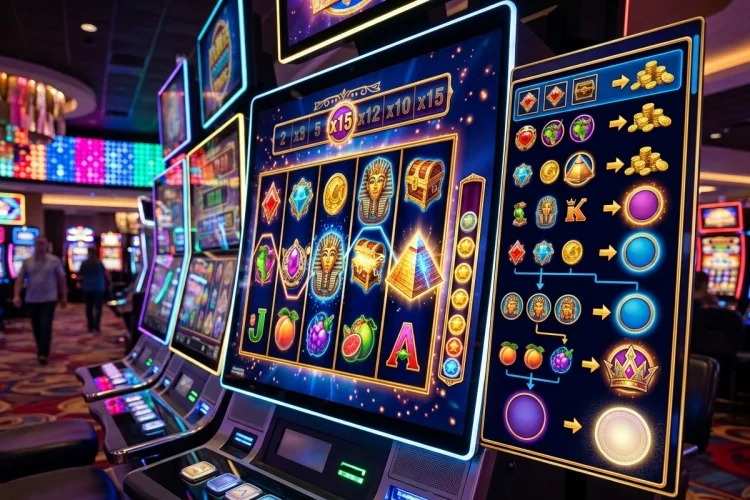
Understanding Slot Symbols, Multipliers, and Bonus Features: A Guide

Understanding Slot Symbols, Multipliers, and Bonus Features: A Guide

A modern slot screen can display dozens of symbols, animated meters, multiplier values, and feature indicators at the same time.

The visual presentation is designed to be engaging, but it can make the underlying payout rules difficult to follow. Understanding slot symbols, multipliers, and bonus features begins with the paytable.

This section explains the value of every icon, how combinations are formed, and which conditions activate special rounds. It also reveals whether multipliers are added together, applied separately, or carried between spins.

Learning these details does not allow a player to predict the next result. It simply makes the cost and possible outcomes clearer. A feature-rich slot can still have high volatility, and a large advertised multiplier may apply only under rare conditions.

By examining each part of the paytable separately, beginners can understand how the base game, special symbols, and bonus mechanics interact without relying on assumptions or promotional language.

Identify the Winning System First

Before examining individual symbols, determine how the game creates wins. Common systems include fixed paylines, ways to win, cluster pays, and all-ways formats.

In a payline game, symbols must usually follow a defined path. Ways-to-win titles normally count matching icons across adjacent reels regardless of their vertical positions. Cluster games reward groups of touching symbols.

The winning system affects how wilds and regular icons are evaluated. A wild on the top row may be useful in an all-ways game but irrelevant to a specific payline that runs across the bottom.

The help screen should state the required direction and minimum number of matching symbols.

Compare Low- and High-Paying Symbols

Low-paying symbols generally appear more frequently and provide smaller awards. Higher-value icons normally appear less often but offer larger paytable amounts.

Suppose three card-rank symbols pay 0.20 times the bet, while three premium icons pay 1.50 times the wager. Both are valid wins, but their financial values differ substantially.

Paytables may list awards for three, four, and five matching symbols. Longer combinations generally pay more, although the increase is determined by the game designer.

A player should also check whether the displayed amount represents the total bet or only the amount assigned to one payline.

Evaluate Every Type of Wild

A standard wild substitutes for ordinary paying symbols. Special versions may expand, become sticky, move between reels, or carry a multiplier.

NetEnt’s Wild Wild West: The Great Train Heist includes regular, expanding, 2x multiplier, and spreading wilds during its free-spin modes. Each variation affects the grid differently, despite sharing the wild label.

Sticky wilds remain fixed for a stated period. Walking or moving versions shift to another position after each spin, while stacked wilds occupy several consecutive spaces on one reel.

Check whether the wild has its own payout and which symbols it cannot replace. Bonus and scatter icons are frequently excluded.

Calculate Multipliers Correctly

A multiplier modifies an eligible prize. If a winning combination pays 5 credits and receives a 4x multiplier, its adjusted value is 20 credits.

The calculation becomes more complicated when several multipliers appear. Pragmatic Play’s Gates of Olympus Super Scatter adds multiplier values together at the end of eligible tumble sequences, with individual symbols reaching as high as 500x.

Other games multiply values together or increase a global meter after every win. A 2x and a 3x multiplier can therefore produce 5x, 6x, or separate awards depending on the published rules.

Players should also verify whether the multiplier applies to one line, one symbol, one cascade, or every win during the feature.

Understand Cascades and Tumbling Reels

Cascading or tumbling mechanics remove winning symbols and replace them with new icons. This allows several consecutive evaluations to occur from one initial paid spin.

Some games increase a multiplier after each successful cascade. Pragmatic Play’s Vampy Party, for example, uses a win multiplier that doubles with each tumble and can reach 1,024x.

A cascade ends when no new qualifying combination appears. The multiplier may then reset before the next paid round unless the rules state otherwise.

Cascades can make a game feel highly active, but they do not guarantee that additional symbols will form another win.

Check How Free Spins Are Triggered

Free spins are often activated by scatters, although some games use collected items, mystery events, or randomly awarded features.

Sweet Bonanza requires four to six scatters to trigger ten free spins. During the feature, multiplier symbols can appear and increase qualifying tumble wins.

Other slots award different numbers of spins according to how many scatters land. NetEnt’s Wild Water offers increasing free-spin totals when three, four, or five scatters appear in the base game.

Check whether free spins can be retriggered and whether the feature changes the reels, symbol values, or volatility.

Examine Bonus Games and Collect Features

A bonus game may ask the player to choose an object, spin a wheel, collect symbols, or fill a progress meter.

Money-symbol and collect features normally display cash values or bet multipliers on individual icons. Pragmatic Play’s Triple Pot Diamond uses money symbols and collect mechanics in its base and bonus games, with additional position-based multipliers during free spins.

Feature terms should explain whether uncollected values are lost, whether symbols remain sticky, and what causes the round to finish.

The size of a displayed prize should always be interpreted relative to the selected wager.

Relate Features to RTP and Volatility

An extensive feature list does not automatically mean a game has a high theoretical return. RTP describes the long-term percentage returned across a very large volume of play.

The UK Gambling Commission explains that actual RTP is calculated by dividing total wins by total turnover. Short sessions can differ significantly from the designed percentage.

Volatility describes how prizes are distributed. A high-volatility game may place more of its theoretical return in less frequent bonus rounds or large multiplier combinations.

Players should assess RTP, volatility, stake range, and feature structure as separate pieces of information.

Understanding slot symbols, multipliers, and bonus features starts with identifying the game’s winning system and reading every section of the paytable.

Standard symbols determine ordinary payouts, while wilds, scatters, cascades, and collection mechanics change how those prizes are formed or enhanced.

Multiplier values require particular attention because different games add, multiply, accumulate, or reset them in different ways. A dramatic maximum value may also depend on several rare conditions occurring together.

Review the rules before selecting a stake, and use demonstration mode to observe how the features interact. Compare RTP and volatility separately from the advertised bonus mechanics.

Set strict financial and session limits, avoid increasing wagers to recover losses, and treat every feature as part of an entertainment product rather than a promise of profit.


Ways-to-Win Slots vs Paylines: How the Systems Differ

Ways-to-Win Slots vs Paylines: How the Systems Differ

Online slots can award prizes through several different matching systems. Traditional titles use fixed or adjustable paylines, while newer games may offer hundreds or thousands of ways to win.

Other releases replace both formats with clusters or cascading grids. This variety can confuse beginners because every system uses reels and symbols but evaluates them differently.

In a payline slot, symbols must normally follow one of the game’s drawn patterns. In a ways-to-win title, symbols usually need only to appear across consecutive reels, regardless of their vertical positions.

Understanding ways-to-win slots and how they work helps players interpret advertised figures such as 243, 1,024, or 4,096 ways. These numbers describe possible symbol routes through the grid, not a guaranteed number of wins.

Before selecting a game, players should compare its winning format, bet structure, paytable, RTP, volatility, and feature rules. The visual size of the grid alone does not explain the complete mathematics.

How Traditional Payline Slots Work

A payline is a predefined path across the reels. It may run horizontally, diagonally, or in a zigzag pattern.

For a payout, qualifying symbols normally need to land on one active line in the correct reel order. Some traditional games allow players to select the number of lines, while modern video slots often activate every listed line with each wager.

NetEnt’s Jack and the Beanstalk, for example, uses five reels and 20 paylines. Its winning-symbol positions must correspond to one of those designated patterns.

A symbol sitting one space above an active line does not contribute to that line’s win, even when matching symbols appear nearby.

How Ways-to-Win Slots Remove Fixed Lines

Ways-to-win slots evaluate matching symbols by reel instead of by drawn line. A symbol may appear anywhere on the required consecutive reels and still qualify.

NetEnt’s King of 3 Kingdoms uses five reels and 243 ways. The ways figure means multiple vertical combinations can connect symbols through the reel set without following fixed line patterns.

For a five-by-three layout, each reel contributes three possible symbol positions. Multiplying the positions across five reels produces 243 complete routes.

This system makes the grid easier to read visually, although players must still understand which reel begins a valid combination.

An Example of Payline and Ways Evaluation

Imagine three crown symbols landing at these positions:

  • Top position on reel one
  • Bottom position on reel two
  • Middle position on reel three

In a payline game, those crowns win only when their positions follow an active line listed in the rules.

In a typical ways-to-win game, they can qualify because they appear on adjacent reels beginning from the left. Their vertical alignment is not important.

If two crowns appear on the first reel, two on the second, and one on the third, the game may count 2 × 2 × 1 = 4 three-reel combinations. The precise prize per combination comes from the paytable.

Ways-to-Win Slots vs Cluster-Pay Games

Cluster-pay slots use another method. Instead of following a line or progressing through reels in the traditional way, they commonly pay for groups of matching symbols touching one another within the grid.

The minimum cluster size and permitted connections vary by game. Some titles count horizontal and vertical contact, while others define winning groups differently.

Play’n GO’s Legacy of Gems Blitzways combines dynamic reel heights, cluster-style wins, cascades, and multiplier wilds, demonstrating that modern games can combine multiple mechanisms.

Players should not use “ways” and “clusters” as interchangeable terms. The information screen determines which system actually applies.

Fixed Ways vs Expanding and Dynamic Ways

A fixed-ways game maintains the same number of symbol positions on each normal spin. Twin Happiness, for instance, advertises 243 ways and requires matching symbols across three or more adjacent reels beginning from the left.

Expanding-reel games may increase the number during a feature. A larger grid creates additional possible routes because more visible positions participate in the calculation.

Dynamic payways change from spin to spin. NetEnt describes Divine Fortune Megaways as using changing reel configurations and changing numbers of winning ways.

The displayed maximum is therefore a ceiling, not necessarily the number available on every paid spin.

Does a Higher Number of Ways Improve the Odds?

A large ways figure creates more possible routes across the grid, but game designers adjust symbol frequencies, payouts, features, and reel mathematics as part of the complete model.

Consequently, 4,096 ways do not make a slot automatically more favourable than one with 20 paylines. Players should compare the stated RTP and volatility rather than relying on the ways figure alone.

The UK Gambling Commission explains that RTP is a long-term average and may differ considerably from the result of an ordinary session. Volatility must also be considered because it affects how widely short-term returns may vary.

Neither measurement predicts the outcome of the next spin.

Reading the Paytable Correctly

Open the game’s help or information menu before placing a wager. It should explain how many matching reels are required, which direction wins are evaluated, and whether different combination lengths are paid separately.

The UK Gambling Commission’s technical standards require licensed games to provide sufficient rules, game descriptions, prize information, and information about the likelihood of winning so customers can make informed decisions.

Also check whether wilds substitute for all symbols, whether scatters pay independently, and whether cascades award repeated evaluations without another paid spin.

Payline slots use predefined patterns, while ways-to-win slots count matching symbols across eligible consecutive reels regardless of their vertical positions.

Cluster games use a third approach based on connected symbol groups, and some modern releases combine several systems. No format is automatically better.

A large number of ways can make the screen more active, but it does not guarantee frequent payouts, higher RTP, or lower risk. Compare the actual paytable, direction of payment, active reel configuration, wild rules, RTP, and volatility before playing.

Try the game in demonstration mode first and set firm limits on spending and session length. Choose a format because its rules are clear and enjoyable – not because an advertised ways figure appears to promise easier wins.

How Do Free Spins Work in Online Slots? A Beginner’s Guide

How Do Free Spins Work in Online Slots? A Beginner’s Guide

Few moments in an online slot feel more exciting than seeing the reels pause with several bonus symbols in view. Music changes, animations begin, and a message announces that a free-spins round has been unlocked.

However, beginners may not immediately understand what happens next or whether these spins are genuinely free.

So, how do free spins work in online slots? In most games, free spins are bonus rounds that allow the reels to spin without deducting an additional stake from the player’s cash balance.

They are commonly triggered by landing a required number of Scatter symbols, although some titles use collected items, random events, or separate bonus purchases.

Free-spin rounds may use the same reels as the base game, but they often introduce additional features. These can include expanding Wilds, sticky symbols, increasing multipliers, tumbling reels, or extra opportunities to retrigger the bonus.

The exact mechanics vary by title. Understanding the trigger, stake value, modifiers, and retrigger rules helps players follow the feature without assuming that every slot operates in the same way.

What Is a Free-Spins Feature?

A free-spins feature is a sequence of slot rounds played without placing a new cash wager before each spin. The game normally uses the stake that activated the feature to calculate any eligible prizes.

For example, when a player triggers ten free spins from a $1 base-game wager, the bonus may continue at that $1 betting level. The player does not usually pay another $10 for the sequence, although the original paid spin was still required to activate it.

The term “free” therefore describes the absence of an additional charge during the feature. It does not mean that the round guarantees winnings or removes the mathematical advantage built into the game.

How Are Free Spins Usually Triggered?

Scatter symbols are the most common trigger. Unlike standard paying symbols, Scatters often do not need to appear along a fixed payline. Instead, the game counts how many land in eligible positions.

In Rich Wilde and the Book of Dead, three Scatter symbols unlock ten free spins. Before the feature starts, one ordinary symbol is selected to become a special expanding symbol throughout the sequence.

Trigger requirements are not universal. Sweet Bonanza requires four to six Scatter symbols to activate its bonus game with ten free spins.

Some games also trigger features through mystery symbols, collected tokens, prize wheels, or random base-game events. The information panel explains which method applies.

What Happens to the Betting Amount?

The stake attached to the triggering spin normally determines the value of the bonus round. If the player changes the wager before activating the feature, the new betting amount may affect subsequent free-spin prizes.

This is why players should check the current stake before pressing the spin button. A larger wager can increase potential payouts, but it also increases the cost of every unsuccessful base-game attempt.

Some promotional free spins work differently. The casino may assign a fixed value, such as $0.10 or $0.20 per spin, which cannot be changed by the user.

The game rules or promotional terms should clearly explain the applicable denomination, number of rounds, and maximum possible reward.

Why Are Free-Spin Rounds Different?

Many slots enhance their mechanics once the feature begins. The objective is to create a bonus experience that differs from ordinary base-game play.

Book of Dead randomly selects an expanding symbol before its free spins. When enough copies land to create a qualifying result, those symbols may expand across their reels.

Sweet Bonanza takes another approach. Its bonus can display multiplier symbols valued from 2x to 100x. After a winning tumble ends, the visible multiplier values are added together and applied to the result.

Other titles may introduce sticky Wilds, additional reels, symbol upgrades, increasing multipliers, or locked positions. These modifiers can improve some outcomes, but they do not guarantee that the sequence will produce a profit.

What Is a Free-Spins Retrigger?

A retrigger occurs when additional bonus symbols land while the free-spins feature is already active. The game then adds more spins or extends the round in another way.

In Book of Dead, landing at least three more Scatters during the feature awards ten additional free spins. Sweet Bonanza 1000 adds five more spins when three or more lollipop Scatters appear during its bonus.

Some slots allow unlimited retriggers, while others set a maximum number of spins. A title may also increase a multiplier or upgrade a symbol instead of awarding more rounds.

Players should review both the initial trigger and the retrigger conditions because they may require different quantities of special symbols.

Are Free Spins Guaranteed to Pay?

No. A free-spins round can produce a large prize, a small result, or no win at all. The term describes how the rounds are funded, not what they will return.

Regulated random games rely on statistical probabilities. The UK Gambling Commission explains that the result of a current random-machine game is not influenced by previous wins or losses.

This means a disappointing bonus does not make a better feature “due.” Similarly, repeatedly landing two Scatters does not prove that the third must appear soon.

Players should avoid chasing another feature simply because an earlier free-spins sequence paid less than expected.

How to Read the Free-Spins Rules

Open the paytable or help menu before playing. It should identify the trigger symbol, required quantity, number of awarded spins, betting value, retrigger conditions, and any special modifiers.

Also check whether Scatter symbols are available on every reel. A game may display five reels but restrict bonus symbols to only three or four of them.

The information screen may also show the return-to-player percentage. RTP is a long-term statistical measurement rather than a prediction for one session.

The UK Gambling Commission notes that a displayed RTP should not be interpreted as the amount a player will receive back from each individual wager.

Free spins are bonus rounds that continue without deducting a new cash stake for every spin. They are commonly activated by Scatter symbols and may introduce expanding Wilds, multipliers, tumbling reels, locked icons, or other enhanced mechanics.

The original triggering wager usually determines the value of the feature. Additional Scatters may retrigger the round, but neither the initial bonus nor extra spins guarantee a payout.

Before playing, open the paytable and confirm the trigger, number of spins, stake value, modifiers, and retrigger rules.

Use only an affordable entertainment budget, set a stopping point in advance, and remember that a bonus feature should never be treated as a reason to chase previous losses.

What Are Wild and Scatter Symbols in Online Slots?

What Are Wild and Scatter Symbols in Online Slots?

Special symbols are one reason modern online slots feel more complex than traditional three-reel machines.

Instead of simply matching fruit or card icons, players may encounter symbols that grow, move, remain locked, increase prizes, or open an entirely different game mode.

This raises an important beginner question: what are Wild and Scatter symbols? A Wild normally supports standard wins by taking the place of another paying icon.

A Scatter usually follows separate rules and may activate free spins, bonus rounds, multipliers, or instant prizes. Although these definitions provide a useful foundation, slot mechanics have become increasingly varied.

A Wild may cover an entire reel, carry a multiplier, move across the grid, or stay fixed during several spins. A Scatter may need to appear anywhere on the screen, on particular reels, or alongside another special icon.

Understanding these differences allows players to follow the action more easily. It also shows why every game’s information panel must be reviewed before making a wager.

How Wild Substitution Works

A basic Wild replaces one or more ordinary paying symbols when the substitution produces a valid result. It does not choose symbols randomly after the reels stop; the game automatically evaluates the best eligible combination under its rules.

Imagine a five-reel slot where four matching character symbols are needed for a payout. If three characters and one Wild occupy the correct positions, the Wild may complete the four-symbol result.

The replacement rule often excludes Scatters and dedicated bonus icons. A Wild may therefore improve a payline without helping the player reach the number of Scatters required for free spins.

Expanding, Stacked, and Spreading Wilds

An expanding Wild grows after landing. Depending on the game, it may cover a complete reel, expand vertically or horizontally, or occupy a group of neighboring positions.

A stacked Wild appears in a vertical block, increasing the possibility of filling several positions on one reel. Spreading Wilds create additional Wild symbols across part of the grid.

Starburst offers a recognizable expanding mechanic. Its Wild covers the full reel when activated, substitutes for paying symbols, and awards a respin.

These features can create visually impressive results, but their activation rules and frequency remain part of the game’s fixed mathematical design.

Sticky, Walking, and Multiplier Wilds

Sticky Wilds remain locked in their positions for a specified number of spins. They often appear during free-spin rounds because retaining them can help create new combinations as the remaining reels continue moving.

Walking Wilds shift one position or reel after each respin. NetEnt’s Halloween Jack uses a Walking Wild that awards a respin and then moves one reel to the left until it exits the screen.

Multiplier Wilds increase a qualifying win by a stated factor, such as 2x, 3x, or 5x. Rules differ when several multiplier Wilds participate: some games add their values, while others multiply them together.

How Scatter Triggers Are Counted

Scatter symbols frequently activate features based on quantity rather than alignment. A game may require three Scatters anywhere on the reels, but another could require four or more.

Dead or Alive awards 12 free spins when at least three Scatters appear anywhere on its reels. During the feature, Sticky Wilds can remain active and qualifying payline wins are doubled.

Other titles scale the reward according to the number collected. This means landing five Scatters may award more spins or a larger prize than landing three.

Players should also check whether every reel can contain a Scatter. Some games limit these symbols to selected reels, which affects how a feature can be triggered.

Scatter Pays Versus Scatter-Triggered Features

Not every Scatter works in the same way. Some provide a separate payout based on the number visible, regardless of whether they form a conventional line.

Other Scatters do not have an independent cash value. Their only purpose may be opening free spins, a pick-and-win round, a prize wheel, or another bonus screen.

Mega Fortune includes clickable Scatter symbols that reveal a win multiplier and the number of free spins awarded. This differs from games in which the feature begins automatically after the required icons land.

The paytable should explain whether the Scatter pays, triggers a feature, or performs both actions.

Combined and Enhanced Symbols

Some developers merge the Wild and Scatter into one icon. This combined symbol can help complete standard wins while also contributing toward a feature requirement.

In Ghost of Dead, Play’n GO describes a special Scatter that can also function as a Wild by substituting for other symbols.

Enhanced Scatters may introduce instant multipliers or larger bonus awards. Gates of Olympus Super Scatter, for example, requires four or more standard Scatters to start its bonus, while Super Scatters can add predetermined instant prizes when they form part of the qualifying trigger.

These labels are not standardized across every provider, so the game rules remain essential.

Do Special Symbols Change the Odds?

Wilds and Scatters can create more ways to form prizes, but they do not remove the house advantage or make a slot predictable. Their possible outcomes, frequency, and awards are incorporated into the game’s mathematical model.

A dramatic feature does not mean the next bonus is “due.” Previous spins do not provide a dependable method for predicting when a Wild or Scatter will appear in a properly random game.

The UK Gambling Commission explains that fully random gaming-machine outcomes are generated independently while the game is designed to achieve its stated long-term return percentage over extensive play.

Players should therefore view special symbols as entertainment mechanics, not as signals that guarantee future returns.

Wild and Scatter symbols perform separate but sometimes overlapping roles. Wilds commonly substitute for paying icons and may expand, stick, walk, spread, or attach multipliers.

Scatters generally pay outside standard lines or unlock features after a required quantity appears. Modern games frequently modify these basic ideas.

Combined Wild-Scatter icons, enhanced Scatters, bonus multipliers, and interactive triggers can make two slots operate very differently even when they use similar terminology.

Open the information panel before playing and examine the symbol chart, feature conditions, RTP, and stake settings. Understanding the mechanics makes the game easier to follow, but always set a strict budget and remember that special features cannot guarantee a profit.