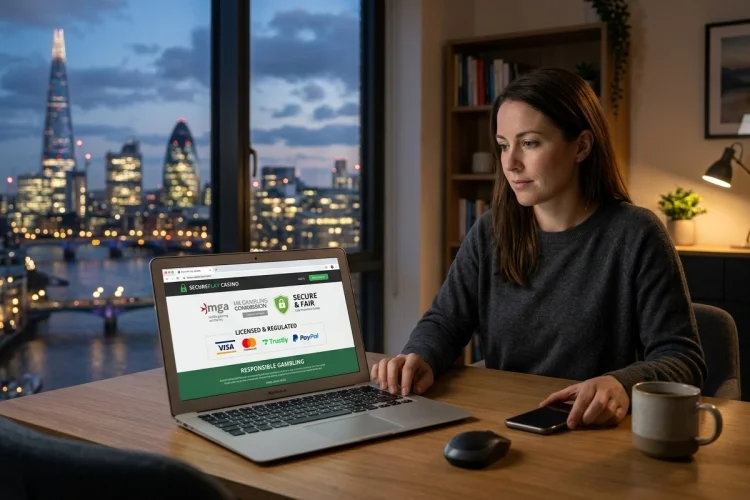
A fake casino website does not always look obviously fake. Modern scam sites can have polished graphics, hundreds of games, live chat buttons, impressive bonuses, and even copied licence logos.
Knowing the Warning Signs of a Fake Casino Website is therefore more useful than judging a platform by appearance alone.
The strongest clues usually involve licensing, domain information, payment methods, withdrawal rules, identity checks, security, and customer support.
Before depositing money or uploading identification, take a few minutes to verify what is actually behind the casino brand.
1. The Licence Cannot Be Independently Verified
A casino claiming to be licensed is not enough.
Fake or unlicensed websites can copy regulator logos, licence numbers, or legal wording from legitimate operators. The safest approach is to verify the operator through the regulator’s own database.
For example, the UK Gambling Commission’s public register allows searches by business name, trading name, and domain. It also displays licence status and regulatory information.
Compare the exact website domain with the domain recorded by the regulator.
A licence belonging to a similar-looking company does not automatically cover another website.
If you cannot identify who regulates the platform or the licence number leads nowhere, treat that as a serious warning sign.
2. The Domain Looks Almost Right
Scammers often benefit from familiarity.
A fake casino domain may differ from a legitimate one by only a letter, extra word, unusual extension, or misplaced character.
For example, a fraudulent site might replace a letter with a similar-looking character or add words such as “official,” “vip,” or “secure.”
The FTC warns that scammers can create websites and search listings that appear connected to trusted companies. Paid search results can also direct users toward misleading sites, so appearing near the top of a search engine is not proof of legitimacy.
Type known website addresses directly when possible, and inspect the domain carefully before entering passwords or financial information.
A professional design cannot compensate for the wrong URL.
3. There Is No Clear Company Behind the Website
Legitimate regulated gambling operators normally identify the legal business responsible for the service.
Look in the footer, terms and conditions, privacy policy, and licensing section.
You should be able to find information such as the company name, regulatory details, contact information, and applicable jurisdiction.
A fake casino may provide only a brand name without identifying who actually operates it.
Other suspicious signs include inconsistent company names across pages or an address that appears unrelated to the gambling business.
Do not assume a long legal-looking paragraph proves anything.
Copying corporate text from another website is easy.
If the ownership details feel deliberately vague, do more research before creating an account.
4. Deposits Are Easy but Withdrawals Are Mysterious
A suspicious casino often explains how to deposit money in great detail while saying very little about withdrawals.
Before depositing, search for minimum withdrawal amounts, processing conditions, identity requirements, fees, and supported payout methods.
A legitimate verification process is not automatically suspicious. Regulated operators may have legal obligations to verify identity.
The warning sign appears when the rules suddenly change after you win.
For British-licensed operators, the Gambling Commission has said that information reasonably needed for identity verification should not be unnecessarily delayed until a player attempts to withdraw. It has also criticised operators for introducing unnecessary friction around withdrawals.
Be particularly cautious if a website demands an unexpected “release fee,” “tax payment,” or additional deposit before allowing a withdrawal.
5. The Casino Pushes Unusual Payment Methods
Payment pressure is another major red flag.
A website might insist that you deposit using cryptocurrency, wire transfers, gift cards, or another method that is difficult to reverse.
Using cryptocurrency alone does not prove a casino is fake. The concern is the combination of pressure, urgency, and limited payment options.
The FTC warns that scammers often tell victims exactly how to pay and favour methods that can be difficult to trace or recover, including cryptocurrency, wire transfers, gift cards, and payment apps.
If the casino tells you that a payment must be made immediately to unlock winnings, pause.
Do not let a countdown timer or support agent pressure you into sending more money.
6. There Are No Real Responsible Gambling Tools
Responsible gambling controls are another useful verification clue.
A regulated casino may provide tools relating to financial limits, self-exclusion, account history, or restrictions on gambling activity.
Research published by the UK Gambling Commission in 2025 found that respondents identified the absence of deposit limits, self-exclusion, or other safer-gambling tools as one potential indicator of illegal gambling websites. Lack of identity or age verification was another commonly reported sign.
Of course, the presence of a “Responsible Gambling” button alone proves very little.
Click it.
Check whether the tools actually exist and whether they can be accessed through the account.
A fake website can easily copy responsible-gambling language without providing real controls.
7. Bonuses Look Unrealistically Generous
Fake casinos often use promotions to make visitors act quickly.
A bonus may promise enormous deposit matches, guaranteed winnings, or huge amounts of “free money.”
The real problem often appears in the terms.
Read the wagering requirements, maximum bet rules, withdrawal restrictions, eligible games, expiry period, and maximum cash-out conditions.
If the casino claims that winnings are guaranteed, treat that claim sceptically.
Gambling outcomes involve uncertainty by definition.
Also be cautious when bonus terms are missing altogether.
A trustworthy platform should make significant conditions available rather than forcing customers to discover them only after depositing.
Large bonuses are marketing. Clear rules are information.
8. Support Avoids Straightforward Questions
Customer support can reveal a lot about a casino before you deposit.
Ask something simple:
Who licenses the casino? What is the minimum withdrawal? Where can you find the complaints procedure?
A legitimate support team should normally be able to direct you to specific information.
A suspicious website may respond with generic sales language, repeatedly encourage you to deposit, or refuse to answer licensing questions.
The UK Gambling Commission says licensed businesses must have fair, open, and transparent complaints procedures. In its jurisdiction, unresolved eligible disputes may also be referred to an Alternative Dispute Resolution provider.
If there is no visible complaints process and no meaningful way to contact the company beyond a chat box, consider that another warning sign.
9. The Website Requests Sensitive Information Through Strange Channels
Casinos may legitimately request identity documents.
How those documents are requested matters.
Be suspicious if someone claiming to represent the casino asks you to send passwords, banking credentials, card PINs, or authentication codes through email, messaging apps, or social media.
The FTC warns that phishing attempts frequently impersonate legitimate businesses and try to obtain passwords, account numbers, or other financial details.
Its guidance recommends contacting companies through contact information you independently know is genuine rather than using unexpected links.
Two-factor authentication can also reduce account risk if a password is compromised.
If an unexpected message asks you to “verify your casino account” through a new link, visit the known casino website directly instead.
A Padlock Icon Does Not Prove the Casino Is Legitimate
One common misconception is that HTTPS automatically means a site is trustworthy.
Encryption is important because it protects information travelling between your browser and the website.
But scammers can also obtain HTTPS certificates.
The padlock tells you the connection is encrypted. It does not tell you that the company receiving your information is legitimate.
That distinction matters.
Licensing, company identity, domain verification, payment policies, and consumer protections still need to be checked separately.
Think of HTTPS as one security requirement, not a complete trust certificate.
What to Do Before Depositing
The easiest approach is to perform a short verification routine.
Check the regulator’s database, match the exact domain, identify the legal operator, read withdrawal terms, inspect responsible-gambling tools, and test customer support.
You should also search independently for regulatory action or credible warnings.
Do not rely entirely on affiliate reviews or social-media recommendations.
UK Gambling Commission research found that consumers who had used illegal websites reported discovering them through search engines, word of mouth, social-media personalities, forums, advertising, and affiliate websites.
Popularity does not equal regulation.
Independent verification is stronger.
The Warning Signs of a Fake Casino Website usually become clearer when you look beyond the homepage.
Unverifiable licences, suspicious domains, hidden ownership, strange payments, unclear withdrawals, missing safeguards, and aggressive support should all prompt caution.
Before sending money or identification, verify the casino through an official regulator and read the important terms yourself. If key information cannot be confirmed, do not rush to deposit.