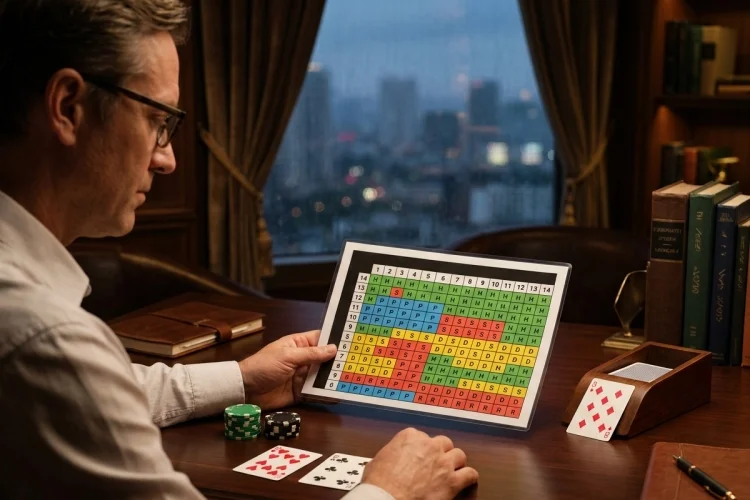
A blackjack strategy chart may look overwhelming when viewed for the first time.
Rows contain player totals, columns show dealer cards, and individual boxes are filled with letters such as H, S, D, P, or R. Despite its appearance, the chart is simply a decision map.
Understanding what Blackjack Basic Strategy is becomes easier when each part of the chart is separated.
The system takes the cards in the player’s hand, compares them with the dealer’s visible card, and recommends the statistically strongest permitted action.
Unlike a betting progression, basic strategy does not tell players how much to wager. It also does not attempt to predict which card will appear next.
Its purpose is to improve playing decisions after the initial cards have been dealt. The most important requirement is using a chart designed for the correct rules.
A strategy for a single-deck game may differ from one designed for six decks. The dealer’s treatment of soft 17 and the availability of surrender or doubling after splitting can also change several boxes.
Reading the Player-Hand Rows
The left side of a strategy chart is normally divided into hard totals, soft totals, and pairs. The player must first identify which category describes the hand.
A hand such as 10-6 belongs in the hard-total section as hard 16. A hand containing A-6 belongs in the soft section because the ace can currently count as 11. Two eights belong in the pair section when splitting is permitted.
Players should not select a row based only on the total. Hard 18, soft 18, and a pair of nines can all equal 18, but they offer different options and therefore require separate strategy decisions.
Correctly classifying the hand is the first step toward using the chart accurately.
Finding the Dealer’s Upcard
The columns along the top represent the dealer’s exposed card, normally from two through 10 and ace. After finding the correct player row, move across until it meets the dealer’s column.
The letter in that box identifies the recommended action. Common chart codes include H for hit, S for stand, D for double, P for split, and R or U for surrender.
Some charts use combined instructions. “Double, otherwise hit” means the player should double when the rules permit it but hit when doubling is unavailable. “Surrender, otherwise stand” gives a similar fallback instruction.
Reading the chart therefore requires understanding both the main action and what to do when that option is prohibited.
Example: Hard 16 Against a Dealer 10
Hard 16 against a dealer 10 is one of blackjack’s most uncomfortable situations. Standing leaves the player with a low total against a strong dealer upcard, while hitting can cause an immediate bust.
In many common multi-deck games, basic strategy recommends surrendering when the option is available. If surrender is unavailable, the chart generally recommends hitting.
Neither choice makes the situation favorable. Basic strategy simply selects the decision expected to lose less over many identical situations.
This example demonstrates an important principle: the correct play is not always the action that feels safest. Standing avoids an immediate bust but may still have a worse expected result.
Example: Soft 18 Against Different Dealer Cards
Soft 18 contains an ace and other cards totaling seven, such as A-7. Because the ace can become one, the hand has more flexibility than a hard 18.
Against some weak dealer upcards, doubling may offer the best expected result. Against certain middle cards, standing is usually preferred. Against a strong upcard such as nine, 10, or ace, the chart may recommend hitting under common rules.
This range of decisions explains why memorizing only the player total is insufficient. The dealer’s exposed card changes how aggressively the hand should be played.
The exact soft-18 recommendations may also change according to whether the dealer hits or stands on soft 17.
Example: Splitting Eights and Keeping Tens
A pair of eights creates hard 16, one of the weakest common starting totals. Basic strategy generally recommends splitting the pair, even against several strong dealer cards.
The purpose is not to guarantee two winning hands. It is to replace one poor hand with two separate starting totals of eight, each of which can be improved independently.
A pair of tens creates 20. Although splitting creates two hands beginning with a strong ten-value card, it also gives up an already powerful total. Basic strategy therefore normally recommends standing.
Players sometimes split tens because they hope to receive two additional tens. This decision is driven by the most attractive possible outcome rather than the complete probability distribution.
Why the Chart Changes With Table Rules
The dealer’s soft-17 rule is one of the most important variations. At an S17 table, the dealer stands on all 17s, including a hand such as A-6. At an H17 table, the dealer must hit that soft total.
The H17 rule generally benefits the casino because the dealer has another opportunity to improve a weak 17. Strategy charts therefore include several different decisions depending on which rule applies.
Deck count, doubling restrictions, surrender availability, resplitting rules, and whether the dealer checks for blackjack can also affect the chart.
The table information panel or felt should display the key rules. Players should read them before choosing a chart.
Basic Strategy and Blackjack Payouts
Basic strategy controls playing decisions, but table selection also affects expected value. One of the most important rules is the payout for a natural blackjack.
Traditional blackjack commonly pays 3:2. At that rate, a $10 wager produces $15 in profit when the player receives a natural and the dealer does not.
Some games pay only 6:5. This means the same $10 natural pays $12, reducing the reward for blackjack. Changing from 3:2 to 6:5 can increase the house edge by roughly 1.4 percentage points.
A player following a perfect chart at an unfavorable 6:5 table may face worse conditions than someone selecting a better-paying game.
Practising Basic Strategy Effectively
Start by learning hard totals because they occur frequently. Then study soft hands and pair-splitting decisions.
Practice should focus on recalling the action quickly and accurately rather than predicting whether it will win. A correct double can lose, and an incorrect hit can occasionally succeed. One result does not prove that the underlying strategy was wrong.
Players can use printable charts or training tools where permitted. Some physical casinos allow strategy cards at the table as long as they do not interfere with play, but local rules should be checked.
Keep betting amounts small while learning. Increasing the stake does not improve the accuracy of the strategy.
A Blackjack Basic Strategy chart converts probability calculations into a practical decision table.
Players identify whether their hand is hard, soft, or paired, locate the dealer’s upcard, and follow the instruction where the row and column meet.
The chart may recommend actions that feel uncomfortable because it compares long-term expected results rather than immediate emotions. It also changes with deck count, soft-17 rules, surrender, and doubling options.
Before playing, confirm the table rules and select a matching chart. Practise reading common hands until the process becomes familiar, avoid 6:5 blackjack where better payouts are available, and use a strict gambling budget.
Accurate decisions reduce mistakes but cannot guarantee session profits.